Product Description
CZPT rollers enhance rotation on the bushing while reducing impact loads on the sprocket tooth during operation.
All components are heat treated to achieve maximum strength. All components are heat treated to achieve maximum strength.
Pre-loaded during the manufacturing process to minimize initial elongation.
Hot dipped lubrication ensures 100% lubrication of all chain components to extend wear life and reduce maintenance costs.
| ISO NO. |
ANSI NO. |
PITCH | BUSH WIDTH |
ROLLER DIA |
PIN | PLATE | TRANS PITCH |
MIN. STRENGTH |
AVG. STRENGTH |
WEIGHT | |||
| d | L1 | L2 | H | t/T | |||||||||
| mm | mm | mm | mm | mm | mm | mm | mm | mm | kgf | kgf | kg/m | ||
| *04C-2 | *25-2 | 6.350 | 3.18 | 3.30 | 2.31 | 7.10 | 7.90 | 5.90 | 0.75 | 6.40 | 7.00 | 8.60 | 0.28 |
| *06C-2 | *36-2 | 9.525 | 4.77 | 5.08 | 3.58 | 11.10 | 12.30 | 9.00 | 1.27 | 10.13 | 15.80 | 20.00 | 0.69 |
| 08A-2 | 40-2 | 12.700 | 7.85 | 7.77 | 3.96 | 15.50 | 16.70 | 12.00 | 1.52 | 14.38 | 27.60 | 34.50 | 1.30 |
| 571A-2 | 50-2 | 15.875 | 9.40 | 10.16 | 5.08 | 19.30 | 20.70 | 15.00 | 2.00 | 18.11 | 43.60 | 59.50 | 2.08 |
| 012A-2 | 60-2 | 19.050 | 12.57 | 11.91 | 5.94 | 24.05 | 25.95 | 18.00 | 2.40 | 22.78 | 62.30 | 80.60 | 3.09 |
| 016A-2 | 80-2 | 25.400 | 15.75 | 15.88 | 7.92 | 30.75 | 33.15 | 23.50 | 3.20 | 29.29 | 111.20 | 134.80 | 5.29 |
| 571A-2 | 100-2 | 31.750 | 18.90 | 19.05 | 9.52 | 37.70 | 41.10 | 30.00 | 4.00 | 35.76 | 173.50 | 224.30 | 8.01 |
| 571A-2 | 120-2 | 38.100 | 25.22 | 22.23 | 11.10 | 47.75 | 51.05 | 35.80 | 4.90 | 45.44 | 249.10 | 326.40 | 11.84 |
| 571A-2 | 140-2 | 44.450 | 25.22 | 25.40 | 12.70 | 51.35 | 55.35 | 41.50 | 5.60 | 48.87 | 338.10 | 409.00 | 14.89 |
| 032A-2 | 160-2 | 50.800 | 31.55 | 28.58 | 14.27 | 61.35 | 65.05 | 48.00 | 6.40 | 58.55 | 444.80 | 556.80 | 20.26 |
| 036A-2 | 180-2 | 57.150 | 35.48 | 35.71 | 17.46 | 69.25 | 73.65 | 54.00 | 7.20 | 65.84 | 560.50 | 652.80 | 27.62 |
| 040A-2 | 200-2 | 63.500 | 37.85 | 39.68 | 19.84 | 75.35 | 79.65 | 59.60 | 8.00 | 71.55 | 693.90 | 921.60 | 33.64 |
| Usage: | Transmission Chain, Conveyor Chain, Roller Chain |
|---|---|
| Material: | Alloy/Carbon Steel |
| Surface Treatment: | Polishing |
| Feature: | Heat Resistant |
| Chain Size: | 1/4"~3" |
| Structure: | Roller Chain |
| Samples: |
US$ 10/Meter
1 Meter(Min.Order) | |
|---|
| Customization: |
Available
| Customized Request |
|---|

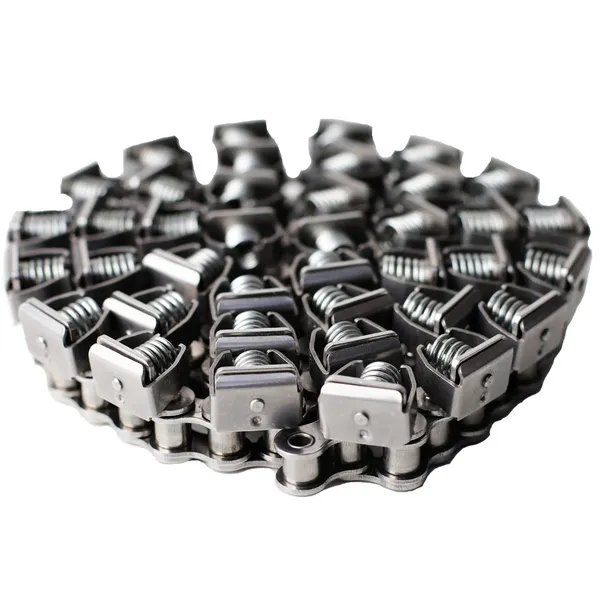
Can a conveyor chain be used in extreme temperature environments?
Yes, conveyor chains can be designed and manufactured to withstand extreme temperature environments. The suitability of a conveyor chain for high or low-temperature applications depends on the material composition and construction of the chain.
1. High-Temperature Environments: For applications involving high temperatures, conveyor chains made of heat-resistant materials such as stainless steel or special alloys are commonly used. These chains can withstand elevated temperatures without significant deformation or loss of strength. They are designed to resist oxidation, corrosion, and thermal expansion, ensuring reliable performance in hot environments.
2. Low-Temperature Environments: Similarly, conveyor chains can also be engineered for low-temperature applications. In cold environments, chains made of materials that remain ductile and strong at low temperatures are utilized. These chains are designed to withstand the effects of cold temperatures without becoming brittle or losing their mechanical properties.
It’s important to consult with conveyor chain manufacturers or experts who specialize in extreme temperature applications to select the most suitable chain material and design. They can provide guidance on factors such as material selection, lubrication, and operational considerations to ensure the conveyor chain performs effectively and reliably in extreme temperature environments.
How do you calculate the power requirements for a conveyor chain?
Calculating the power requirements for a conveyor chain involves considering various factors. Here’s a step-by-step process:
1. Determine the total weight to be transported: Measure or estimate the total weight of the material or product that will be carried by the conveyor chain. This includes the weight of the product itself, any packaging, and additional loads.
2. Determine the speed of the conveyor: Determine the desired speed at which the conveyor chain will operate. This is typically measured in feet per minute (FPM) or meters per second (m/s).
3. Calculate the required capacity: Multiply the total weight by the desired speed to determine the required capacity of the conveyor system. This will give you the weight per unit of time (e.g., pounds per minute or kilograms per hour).
4. Consider the conveyor’s design factors: Take into account various design factors such as the type and pitch of the conveyor chain, the coefficient of friction between the chain and the conveyor components, and any incline or decline angles of the conveyor system. These factors affect the power requirements.
5. Determine the required power: Use the following formula to calculate the power requirements:
Power (in horsepower) = (Capacity × Friction Factor) ÷ (33,000 × Efficiency)
Where:
– Capacity is the weight per unit of time (from step 3)
– Friction Factor is the ratio of chain tension to chain weight, taking into account the design factors
– 33,000 is a conversion factor to convert the units to horsepower
– Efficiency is the overall efficiency of the conveyor system, typically expressed as a decimal value (e.g., 0.95 for 95% efficiency)
6. Select a suitable motor: Based on the calculated power requirements, select a motor that can provide the necessary power to drive the conveyor chain. Consider factors such as motor type, motor efficiency, and overload capacity.
It’s important to note that the power requirements may vary depending on specific conveyor system designs and operating conditions. Consulting with a qualified engineer or conveyor manufacturer is recommended to ensure accurate calculations and proper motor selection.

What are the different types of conveyor chains?
There are several types of conveyor chains available, each designed to meet specific application requirements. Here are some common types of conveyor chains:
- Roller chains: Roller chains are the most commonly used type of conveyor chain. They consist of a series of cylindrical rollers connected by side plates. Roller chains provide smooth and efficient movement and are suitable for medium to heavy-duty applications.
- Double pitch chains: Double pitch chains have larger pitch (distance between the centers of adjacent pins) compared to standard roller chains. They are often used in applications that require slower speeds and lighter loads.
- Hollow pin chains: Hollow pin chains have hollow pins that allow for easy attachment of various accessories or attachments. They are commonly used in conveying applications that require customization or where attachments need to be mounted.
- Apron or slat chains: Apron or slat chains consist of plates or slats that are connected by hinges. They are used in heavy-duty applications where the chain needs to support and carry large loads or withstand harsh environments.
- Plastic chains: Plastic chains are made of durable and lightweight materials such as acetal or polyethylene. They offer benefits such as corrosion resistance, low noise levels, and the ability to work in wet or washdown environments. Plastic chains are commonly used in food processing, packaging, and pharmaceutical industries.
These are just a few examples of conveyor chain types, and there are many other variations available depending on specific application requirements. The selection of the appropriate conveyor chain type depends on factors such as load capacity, speed, environment, and desired functionality.


editor by CX 2023-08-18